
Site Structure – The easy guide
Reading time: 5 minutes

Ever heard the saying, “Don’t build a house on sand”? Well, the same goes for your website. Without a solid site structure, you’re basically tossing your content into the digital void and hoping Google finds it.
In this guide, I’ll walk you through how to nail your site structure for SEO. Whether you want to rank your site in Google or just understand why your traffic isn’t climbing, I’ve got you.
Let’s build something that actually gets clicks.
Okay, so here’s the deal – your site structure really matters if you want to rank on Google. When your site is structured well, it helps search engines understand what your content is about and which pages matter most giving you a solid foundation for better search optimization.
It also makes it easier for visitors (and Google!) to click around without getting lost, which is super important if you want to rank your site in Google. Good structure = better website seo ranking.
Common Mistakes
One thing I’ve seen over and over again is people unintentionally messing up their SEO structure for their website without even realizing it. A few common mistakes? Here’s what to watch out for:
yourdomain.com/page123?id=xyz don’t tell Google (or users) anything about the content.If you want your website to rank your site in Google, you’ve gotta have the right building blocks in place. The key elements of a site structure for SEO are actually pretty simple.
First, make sure your main pages are easy to find – think clear navigation menus and logical categories.
Then, use internal links to connect related content so nothing’s floating out there alone.
Keep your URLs clean and readable – no weird codes or gibberish. And don’t forget a sitemap! It’s like giving Google a map of your site so it doesn’t get lost.
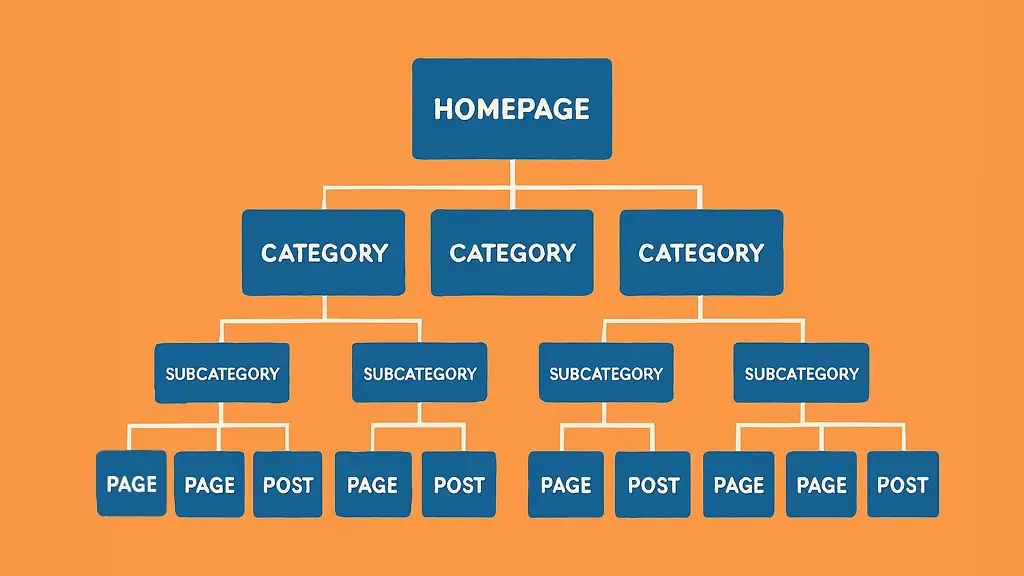
Think of a good site structure like a pyramid. At the very top is your homepage, the main hub. Just below that are your key sections or categories – like the big topics your site covers. Under those, you might have subcategories if things get more specific.
And at the bottom, holding everything up, are all your individual blog posts and pages. It’s a clean, organized setup that makes it super easy for both users and search engines to navigate.
When your site structure follows this kind of logic, it supports both website design and SEO – helping your site look good and rank even better in Google.
Let’s talk internal linking – it’s one of those sneaky-powerful things that can seriously boost website seo ranking if you do it right.
Internal links help Google understand how your site is structured and which pages matter most, which is key if you’re trying to rank your site in Google. It also plays a big role in website design and SEO, because a well-linked site not only looks more organized but also works better for users and search engines alike.
The trick is to use smart anchor text and keep it contextually relevant – don’t just link the word “click here”. You also want to make sure you’re fixing orphan pages (pages with no links pointing to them) because they’re basically invisible to search engines.
Alright, once you’ve nailed the basics of site structure, it’s time to level up and really boost that website SEO ranking. One powerful move is building content clusters – organizing your posts around key topics to show Google you’ve got serious topical authority.
Then there’s the technical stuff: using HTTPS, speeding up your site, and keeping your Core Web Vitals in check all support a solid structure by making things faster and more secure. Don’t skip structured data either – things like review schema can land you in those fancy Google snippets.
And believe it or not, your homepage layout plays a huge role in your SEO structure for website – it should guide users clearly to your main sections without being a cluttered mess.
Want to see how it’s all working? Google Search Console is your best friend for tracking how your structure impacts performance.
So yeah, it’s not just about keywords or content—it’s about the bones of your website. Your site structure is the silent MVP of your entire search optimization strategy. If you want to truly rank your site in Google, focus on your SEO structure for website from day one. Your website SEO ranking depends on it.
And if some of this sounds new to you, check out my other post, Start Ranking Higher: Understanding SEO Basics – it lays the groundwork so all this advanced stuff makes way more sense.
 Creative presentation ideas everyone should know
 Valuable Content: A Practical Checklist
 Search Experience Optimization (SXO): What It Is and Why It Matters
 E-E-A-T: What It Is & Why Does It Matter for SEO
 Content Refresh: What It Is and How to Do It Right