
E-E-A-T: What It Is & Why Does It Matter for SEO
Reading time: 4 minutes

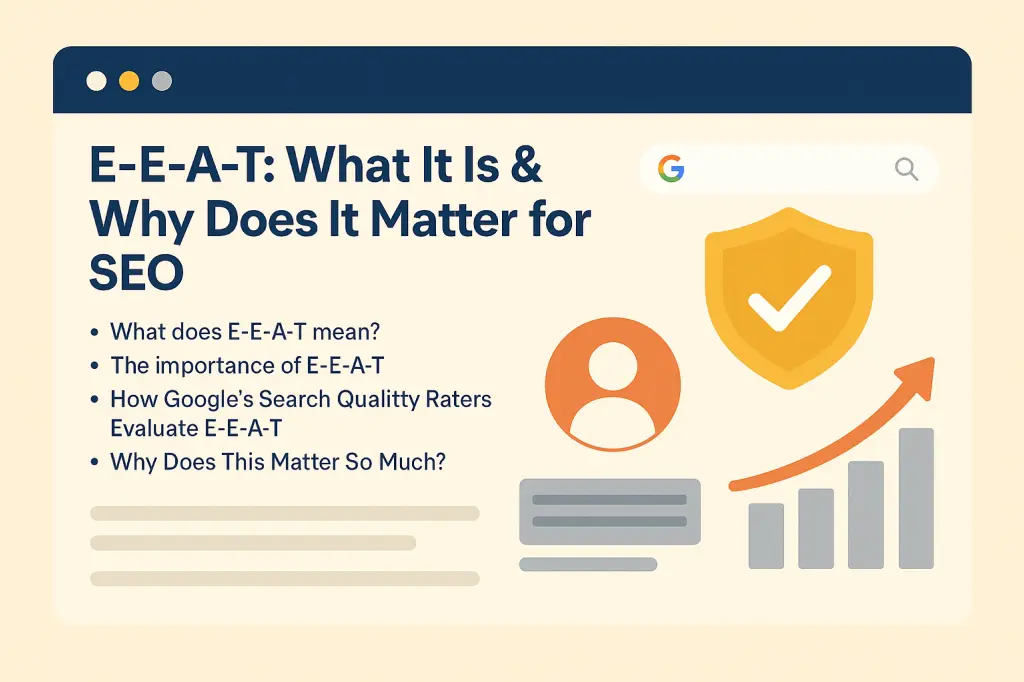
E-E-A-T strengthens your brand’s credibility and positions your content as trustworthy and authoritative in Google’s eyes.
E-E-A-T stands for Experience, Expertise, Authoritativeness, and Trustworthiness. Originally introduced by Google in its Search Quality Rater Guidelines back in 2014 as EAT, the concept was expanded in 2022 with an added emphasis on Experience.
Ever since Google rolled out E-A-T, many business owners and marketers have been unsure about what it really means and how it affects search rankings. Now, with “experience” added to the mix—turning EAT into E-E-A-T—and the 2022 Helpful Content update in play, it’s more important than ever to understand how Google evaluates content through this lens if you want to rank well and stay on top in the SERPs.
E-E-A-T signals play a key role in how Google assesses the overall quality of a webpage, which directly impacts how that page ranks in search results.
Google prioritizes E-E-A-T to ensure it delivers the most trustworthy, reliable, and valuable content in response to every search query.
This approach benefits users by delivering higher-quality search results, while also rewarding brands and content creators who invest in showcasing real expertise and authority in their niche.
This is especially important for YMYL (Your Money or Your Life) topics, where accuracy and trust are crucial. In these cases, users need to feel confident in the information they’re getting. Content created by individuals with firsthand experience is often viewed as more credible and dependable.
Users also tend to value content from people with firsthand knowledge and real-life experience—no matter the topic. Whether it’s a product review, travel guide, or technical tutorial, insights from someone who’s actually been there or done it carry more weight.
The Search Quality Evaluator Guidelines are used by human quality raters to assess websites and search results. This detailed, 181-page document lays out step-by-step instructions for evaluating the quality of a web page.
Google’s Search Quality Raters Include:
E-E-A-T is important because it helps Google guide users to the most helpful, high-quality content for their search queries. At its core, the goal is to make the web better and more trustworthy for real people.
Assessing the trustworthiness of content also helps create a safer browsing experience for users, especially those who might be vulnerable to scams, misinformation, or identity theft.
Neglecting to optimize these signals can lead to lower rankings, reduced traffic, fewer leads, and ultimately, less revenue. If you’re not clearly demonstrating experience, expertise, authority, and trust, Google is more likely to favor your competitors’ content and your potential customers could end up there instead.
There’s been plenty of confusion and debate around whether EEAT is actually a ranking factor.
Technically speaking, a ranking factor is something concrete and measurable like the number of backlinks or page speed—that an algorithm can analyze.
In contrast, experience, expertise, authoritativeness, and trustworthiness are more subjective qualities, often rooted in human judgment.
By following these principles and regularly producing content that reflects strong E-E-A-T, you’ll set yourself up to gain both search visibility and user trust.
As search engines continue to emphasize quality and credibility, this is a smart, long-term investment in your SEO strategy.
Want to keep learning? Check out our Small SEO Guide for Beginners for a simple, step-by-step breakdown of SEO essentials to help you build a solid foundation and grow your site traffic.
 Creative presentation ideas everyone should know
 Valuable Content: A Practical Checklist
 Search Experience Optimization (SXO): What It Is and Why It Matters
 Content Refresh: What It Is and How to Do It Right
 Why Lastmod Tag is important for your sitemap